

Last Updated: November 14, 2026
Quick Summary
A feelings chart for children is a visual display of faces or characters, each labelled with an emotion, that helps children point to and name how they feel. Choose a chart suited to the child's age, with four to six core emotions for toddlers and more nuanced feelings for older children. Use it at child height during calm moments, and let the child point rather than explain.
- Pick four to six core emotions for children aged two to four.
- Place the chart at child height so they can reach it without asking.
- Ask 'Which face is closest to how you feel?' rather than 'Are you sad?'
- Introduce the chart during a calm moment, not during a meltdown.
- Respect refusal and offer the chart again on another day.
Table of Contents
- Why a Feelings Chart Helps Children Name Their Emotions
- Choosing a Free Printable Emotions Chart for Kids
- How to Use a Feelings Chart with Children
- Using a Feelings Chart in the Classroom
- Feelings Storybooks for Childminder Settings
- Common Behaviour Challenges and Questions Answered
- Start Naming Feelings with Your Child Today
- Frequently Asked Questions
Every parent, teacher and childminder has seen a child go from calm to overwhelmed in seconds, with no words to explain why. A feelings chart for children gives that child a way to point, choose and begin naming what is happening inside. The Mood Munchers resources are built around the idea that emotions are visitors, not identities, and a good printable chart fits neatly into that approach.
Why a Feelings Chart Helps Children Name Their Emotions
A feelings chart is a visual display of faces or characters, each showing a different emotion with its name underneath.
Naming a feeling gives the child a little distance from it. When a child can say "I feel frustrated," the feeling becomes something they have, rather than something that has them.
Used regularly, a chart can help build emotional vocabulary, giving children a wider set of words to explain what has happened and ask for help.
Choosing a Free Printable Emotions Chart for Kids
Searches for a free printable emotions chart for kids bring up a lot of options, and not all of them suit every child. Before you print, think about the child's age, developmental stage and communication needs. The chart style you choose matters as much as the feelings it shows.
Matching chart style to developmental stage
Toddlers and early years (ages 2-4). Children are just beginning to recognise that feelings have names.
Preschool and reception (ages 4-6). Children can now handle a wider vocabulary and begin to link feelings to causes. Look for charts that include surprised, worried, frustrated and calm alongside the basics.
Key Stage 1 and lower Key Stage 2 (ages 6-9). Children at this age can understand that feelings come in different intensities.
Upper Key Stage 2 and beyond (ages 9-11). Older children may find picture-based charts a little young. Look for charts with more nuanced vocabulary and perhaps a wheel format that clusters related feelings. The Meet the Mood Munchers Key Stage 2 edition is written for older children and explains how to navigate feelings when they come up.
Comparing chart formats
Simple faces chart. Best for younger children or those new to emotional language. Clear, uncluttered and easy to use.
Emotion wheel. Shows a spectrum of feelings and how they relate. Good for older children and adults.
Intensity scale or thermometer. Helps children gauge how strong a feeling is. Useful for anger or anxiety. Limitation: requires some abstract thinking.
Larger vocabulary chart. Lists many feeling words with or without faces. Suitable for children with good reading skills.
Customising for individual needs
No chart will fit every child. Consider adapting a printable by:
- Reducing the number of feelings to those the child recognises.
- Adding photos of the child or familiar adults showing the feelings.
- Translating feeling words into the child's home language alongside English.
- Using a black-and-white version for children who find colour distracting or who prefer to colour it in themselves.
- Adding a "something else" option for feelings not on the chart.
Watch out: avoid choosing a chart solely because it is visually appealing to you. The child's ability to use it independently is the best measure of whether it is suitable.
Inclusive design considerations
Not all children respond to facial expressions or colour-coded charts. Some children may find photographs of faces easier to read than illustrations, or may prefer text-only lists. Children with visual impairments may need high-contrast, large-print charts. Children who are non-speaking may benefit from a chart that uses symbols alongside words. Our Emotional Literacy Resolutions can also help settings plan how to make emotional learning accessible for every child.
How to Use a Feelings Chart with Children
A chart only works if it is used. Here is a simple approach that parents, childminders and teachers can start with today.
- Put the chart at child height. Stick it on a wall, fridge or in a calm corner where the child can reach it without asking.
- Introduce it during a calm moment. Sit together and point to each face, saying the name and what it looks like.
- Model it yourself. Say, "I feel a bit tired today, that looks like this one."
- Ask a gentle question. Try "Which face is closest to how you feel right now?" rather than "Are you sad?"
- Use it during emotional moments, briefly. "Can you show me which face is you right now?" Keep it short, the aim is connection, not interrogation.
- Follow up later. At bedtime or during a quiet moment, revisit the feeling and what caused it.
Watch for signs that a child is not ready for a question. If they are shouting or crying hard, first help them feel safe and settled. The chart can come later.
A chart only works if it is used. Here is a simple approach that parents, childminders and teachers can start with today.
| Step | What to do | When |
|---|---|---|
| Place the chart | Stick it on a wall, fridge or calm corner at child height | Before first use |
| Introduce it | Sit together and point to each face, saying the name | During a calm moment |
| Model it | Name your own feeling using the chart | Throughout the day |
| Ask gently | Ask "Which face is closest to how you feel?" | At any time |
| Use briefly | Ask the child to show their face during emotional moments | Keep it short |
| Follow up | Revisit the feeling and what caused it | Later, such as bedtime |
Using a Feelings Chart in the Classroom
In a classroom, a feelings chart works best as part of a predictable routine, not as an emergency tool. Many teachers use it during a morning check-in, where each child points to a face or places a name card under the feeling that matches their day. This takes less than a minute per class and gives you a useful picture of how the group is doing.
Practical scripts for checking in
How you ask matters as much as what you ask. These short, nonjudgmental prompts can be used throughout the day:
- "Which face is closest to how you feel right now?"
- "I wonder if you can show me with the chart."
- "Sometimes it helps to point. Would you like to?"
- "That looks like a tricky feeling. I'm here when you want to talk."
- "You don't have to say anything. Just pointing is enough."
Avoid asking "Why do you feel like that?" during a moment of strong emotion. Children often cannot answer, and the question can feel like pressure. Instead, acknowledge the feeling first: "I can see you've chosen frustrated. That's a big feeling. Let's take a moment." Later, when the child is calm, gently explore what happened.
Responding without pressuring
A chart should never become a tool for compliance, requiring a child to point to a feeling before they can have help, or using it to prove a child is "wrong" about their feelings. The chart is an invitation, not a test. If a child refuses, respect that: "That's okay. The chart is here if you want it later." Model it yourself: "I'm feeling a bit overwhelmed today, so I'm going to point to this one."
Classroom routines that work
Morning check-in. As children arrive, they can move their name card to a feeling on a large class chart.
Calm corner. Display a smaller version of the chart in your calm corner or reading area, along with a few comfort items.
End-of-day reflection. A quick round where children share one feeling from the day can build emotional vocabulary and community. Use the chart as a visual reference.
Limitations and safe use
A feelings chart supports conversation; it does not diagnose emotions or replace individualised support.
Watch out: avoid displaying individual children's feelings publicly if this could cause embarrassment or bullying. Use name cards that can be turned face down, or keep the check-in private.
For more practical ideas, read our A Teacher's Guide to Managing Classroom Behaviour Through Emotions, and when a child is dealing with tantrums after school, our How to Calm a Child After Tantrums at School Pickup guide covers specific steps.
Feelings Storybooks for Childminder Settings
Childminders work with mixed ages and often have limited space and time. A feelings storybook is practical because it can be read aloud to a small group, passed between children, or used one-to-one when a child needs comfort. Choose a book whose characters match the feelings you see most often. A single well-chosen book, read again and again, can do more than a shelf of books read once.
Common Behaviour Challenges and Questions Answered
My child refuses to point to any face. What should I do? Do not push.
The chart is not helping during meltdowns. Is that normal? Yes.
My child keeps picking the same face. Is something wrong? Not necessarily. Children often pick the feeling they are experiencing most.
Will a feelings chart work for children with additional needs? Many children who use visual supports respond well to picture-based tools.
Is a chart enough on its own? A chart is a starting point.
Start Naming Feelings with Your Child Today
Naming feelings is a useful habit a child can build, and it can start with a single conversation. Print a chart, put it at child height, and begin with one question at a calm moment. Over time, that question becomes a shared language between you and the child.
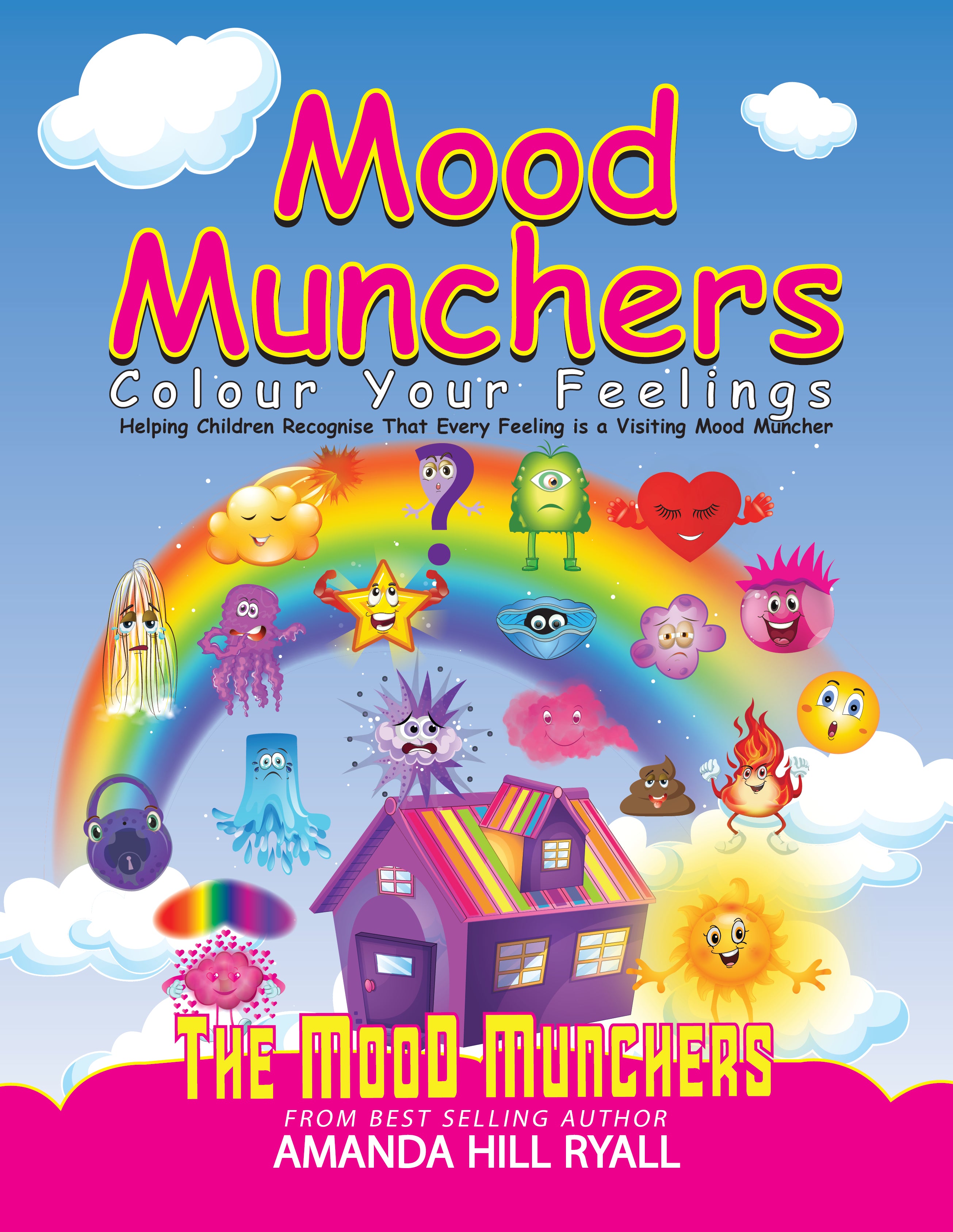
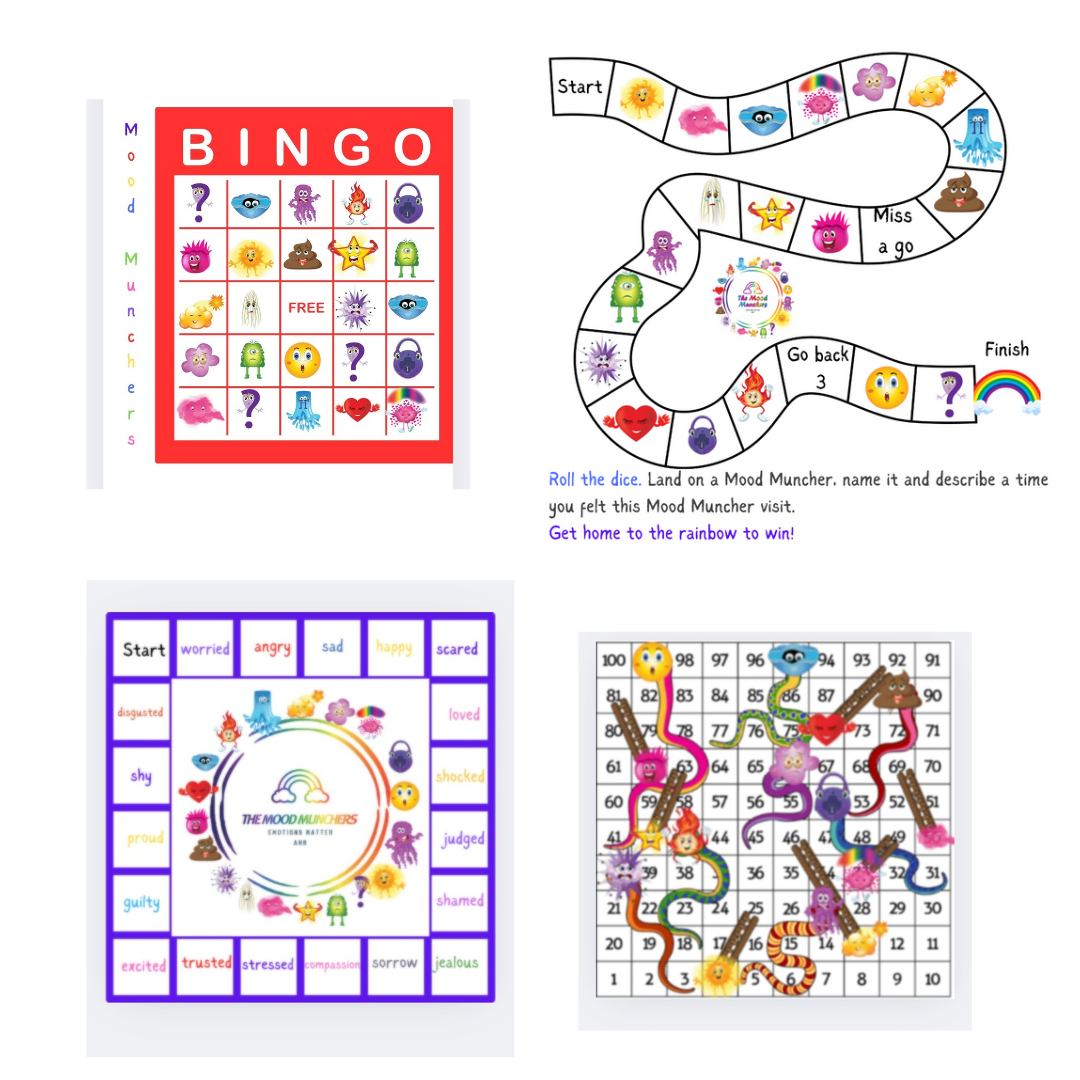
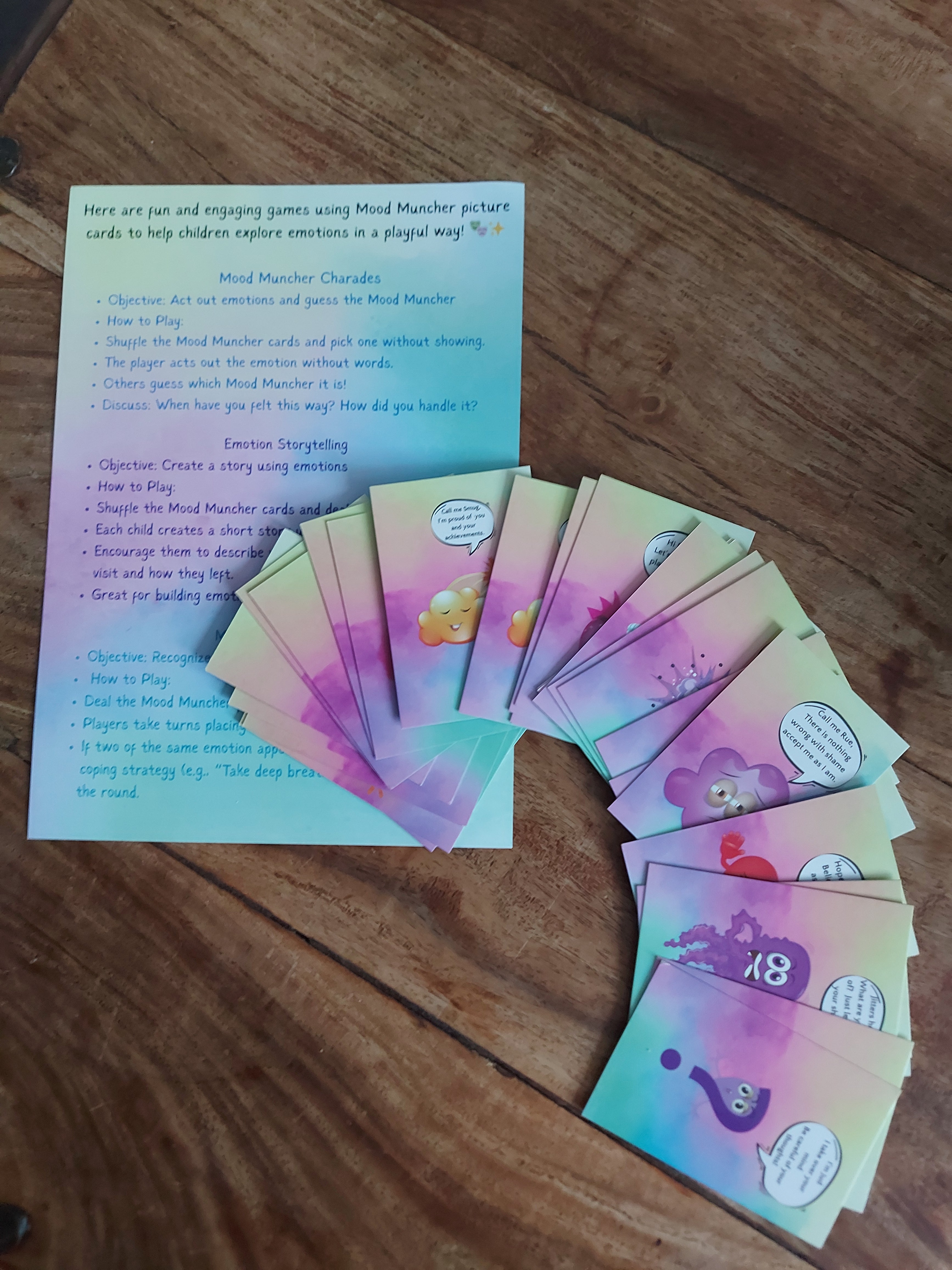
Explore our Meet the Mood Munchers Early Years Edition to bring characters and storytelling into your home or setting, or browse our parent collection of books and resources for more ways to support emotional literacy. You can also see the full range in our Colour Your Feelings with the Mood Munchers book, which is designed for children aged 3 to 10. Our Games and Card Games bring the same language into play.
Frequently Asked Questions
What is a feelings chart for children?
A feelings chart is a printed poster that shows faces or characters, each labelled with an emotion such as happy, sad, angry, worried or calm. Children point to or name the face that matches how they feel. It gives young children a visual reference when words are hard to find. Many charts are designed for specific age groups, so choosing one with clear faces and simple labels works best for children aged 4 to 10. Adults can use it as a starting point for conversations about feelings rather than as a test of a child's emotional vocabulary.
How do you use a feelings chart with a child?
Display the chart at the child's eye level and point to a face when you notice a feeling, for example, 'You look a bit frustrated, is that right?' Ask the child to choose the face that matches their feeling, and accept whatever they pick without correction. Use it at calm moments as well as during difficult ones, so the chart feels familiar rather than only linked to trouble. Keep sessions short, and praise the child for naming a feeling, whichever feeling it is.
Which feelings should a children's emotions chart include?
A useful chart covers a range of feelings rather than only happy and sad. Look for faces representing happiness, sadness, anger, fear or worry, surprise, excitement, frustration and calm, at minimum. Charts that show how feelings look in the body, such as a tight tummy or clenched fists, help children connect feelings with physical sensations. Avoid charts that only show positive feelings, because children need words for difficult emotions as well as pleasant ones.
What is the difference between a feelings chart and an emotions wheel?
A feelings chart usually shows a small set of clearly drawn faces, which suits children aged 4 to 7 who are still building emotional vocabulary. An emotions wheel groups feelings into families and shows more subtle words, such as annoyed, disappointed or nervous, which suits older children and pupils aged 8 to 10. Many teachers start with a chart and move to a wheel as children's vocabulary grows. Either tool works best when adults use it in everyday conversation.
