

Table of Contents
- Why Emotional Literacy Tools Belong in Every Childminding Setting
- How to Help Children Name Their Feelings: The Core Skill
- Choosing a Feelings Chart for Children That Actually Gets Used
- Emotional Literacy Activities for Early Years: Games, Play and Daily Routines
- Books About Emotions for Children: Reading Together to Build Understanding
- Age-Specific Tools: Babies, Toddlers and Preschoolers
- Inclusive Practice, Safeguarding and Working With Families
- Conclusion
- Frequently Asked Questions
Last Updated: October 18, 2026
Why Emotional Literacy Tools Belong in Every Childminding Setting
Emotional literacy is the ability to recognise, name, understand and express feelings in a healthy way. At The Mood Munchers, we build our whole approach around one idea: children who can name a feeling are far less likely to be overwhelmed by it.
The case for prioritising this work is straightforward. Early years settings shape how children learn to handle big emotions, and the Early Years Foundation Stage statutory framework treats personal, social and emotional development as a prime area of learning.
But here is what most guides get wrong. They hand you a printable and call it done. A feelings chart on the wall that nobody uses helps no one.
Below, we break down the practical picks, how to set them up, and how to adapt them for mixed ages and additional needs.
How to Help Children Name Their Feelings: The Core Skill
Helping children name their feelings is the foundation of everything else. A child who can say "I'm frustrated" has a tool. A child who can only scream has none.
The process is simple, but it takes repetition:
- Notice the feeling out loud: "You look cross."
- Offer a word: "That's frustration."
- Link it to the body: "Your fists are tight."
- Accept it without judgment: "It's okay to feel cross."
- Coach the next step: "Let's take a breath together."
This is emotional coaching in action. You connect first, then calm, then coach. Skip the connection and the rest falls flat.
Building an Emotional Vocabulary in Small Steps
Start with four core feelings: happy, sad, angry, scared. Add shades as children grow. "Frustrated" before "irritated". "Worried" before "anxious".
A common mistake is flooding children with a huge feelings wheel on day one. In practice, most children do better with a small, familiar set they use every day. Keep it to six words maximum for toddlers. Preschoolers can handle eight to ten.
Choosing a Feelings Chart for Children That Actually Gets Used
A feelings chart for children only works if it is used, not just admired. The best charts sit at child height, use clear faces, and get touched every day. But in a home-based setting the chart has to survive toddlers pulling at it, fit a living room wall without dominating it, and work for a two-year-old and a five-year-old on the same day.
Here is how we would choose one for a childminding setting:
- At child height. If a child cannot reach it, it is decoration. Aim for the lower half of the wall, roughly 60-90 cm from the floor, so a toddler can point without an adult lifting them.
- Clear, simple faces. Six to eight emotions, not twenty. A crowded wheel overwhelms the under-fives who need it most.
- Interactive. Velcro, magnets or moveable markers beat static posters. The act of moving a marker gives a child something to do with the feeling while they find the word.
- Durable and wipeable. Laminated or fabric charts survive daily handling, sticky fingers and the occasional tug. Avoid cardstock that bends at the corner within a week.
Setting it up so it actually gets used
Placement matters more than the chart itself. Put it where children already pause, beside the snack table, near the coat pegs, or in the cosy corner, rather than on a wall they walk past.
Introduce it in three steps:
- Model it first. Use the chart yourself out loud: "I'm feeling a bit tired today, I'll point to tired." Children copy what they see before they use it independently.
- Do it together. For the first week, point and name for the child: "You look cross, shall we find cross on the chart?"
- Step back. Once the child reaches for it unprompted, your job is to respond, not lead.
For mixed ages, keep one chart but two entry points. Toddlers point at a face; preschoolers can add a word card or a marker. The same chart then serves the whole group without a second display.
A chart is a prompt, not a test. If a child does not want to use it, offer it once and move on, pressure turns a useful tool into a demand.
Emotional Literacy Activities for Early Years: Games, Play and Daily Routines
Emotional literacy activities for early years work best when they are playful and woven into the day. Games lower the pressure, and play lets children practise feelings safely.
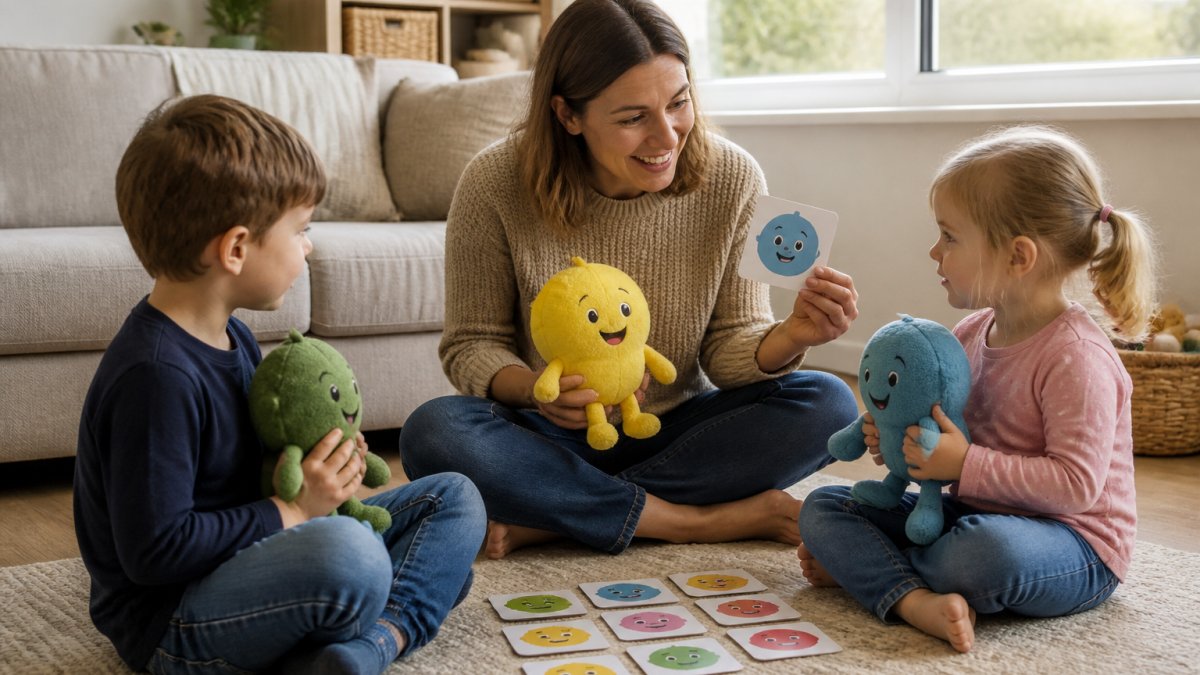
Try these:
- Feelings charades. Pull a face, others guess the emotion.
- Story puppets. Soft toy characters act out a small worry.
- Emotion sorting. Match cards to faces on a chart.
- Role play. "The teddy is sad because his friend left."
- Feelings check-in. A quick round at snack time.
For children who find words hard, tactile tools help. Soft toy characters give a child something to hold while they talk, which takes the pressure off eye contact. Many childminders tell us this is the moment a quiet child finally opens up.
Calming Strategies and Physical Release
Naming a feeling is step one. Regulating it is step two. Calming strategies and physical release give children somewhere to put the energy.
- Breathing exercises. "Smell the flower, blow the candle."
- Counting to ten. Slow and out loud together.
- Physical release. Star jumps, squeezing a cushion, pushing a wall.
- A safe space. A cosy corner with soft toys and a chart.
Self-regulation builds through co-regulation first. Your calm nervous system helps settle theirs. Model it out loud: "I'm feeling frustrated, so I'm going to take three breaths."
Books About Emotions for Children: Reading Together to Build Understanding
Books about emotions for children do something a chart cannot. They let a child watch a character feel something and come through it.
Reading together also builds emotional vocabulary naturally. A story repeats the same feeling words in context, and repetition is how children learn.
What to look for:
- A clear feeling at the centre of the story
- A character the child can relate to
- A resolution that shows coping, not avoidance
- Pictures that show the feeling in the body
Our own storybooks pair each feeling with a soft toy character, so children can hold the feeling while they hear about it.
Age-Specific Tools: Babies, Toddlers and Preschoolers
One collection rarely suits every age. Match the tool to the stage and you get far more from it. The table below is a starting point, but the notes underneath matter more than the grid, they explain why each tool works at that stage and how to adapt it when you mind mixed ages in one room.
| Age | What works | Example tools | When to introduce |
|---|---|---|---|
| Babies (0-2) | Tone, faces, comfort | Soft toys, gentle books, your calm voice | From the first settling-in session |
| Toddlers (2-3) | Naming, simple choice | Four-feeling chart, soft characters, action songs | Once the child points and uses single words |
| Preschoolers (3-5) | Vocabulary, play | Storybooks, charades, feelings check-in | When pretend play begins |
| Older children (5-7) | Reflection, coping | Emotion cards, breathing games, simple journaling | When they can recall a feeling after the event |
Babies (0-2): co-regulation before words
Babies do not need a chart. They need your face, your tone and your calm body. Narrate feelings simply, "You're cross, that was loud", and pair the word with comfort. Soft toys and gentle board books give a baby something to hold while you speak. The tool here is you, and the aim is to build the association between a feeling and a calm response.
Toddlers (2-3): naming with a small set
Toddlers can point before they can say. Keep the set to four core feelings, happy, sad, angry, scared, and add one shade at a time. Action songs and soft characters let a toddler act out a feeling physically, which suits their development better than a worksheet. Introduce the chart when the child is already pointing at pictures and using single words; retire the four-feeling set only when they start offering a fifth word unprompted.
Preschoolers (3-5): vocabulary through play
Preschoolers can handle eight to ten feeling words and enjoy role play. Storybooks, charades and a snack-time check-in all work because they let the child try a feeling at a safe distance. This is the stage where a child may say "I'm frustrated" instead of hitting, the word does the work the behaviour used to do.
Older children (5-7): reflection and coping
Once a child can recall a feeling after the event, introduce simple coping tools: emotion cards, breathing games and a basic journal with a face and a word per page. Keep it low-pressure. The aim is reflection, not a written record you assess.
Adapting for mixed ages in one setting
Most childminders mind a spread of ages at once, so plan for one flexible set rather than four separate kits. Choose tools with moveable parts and open-ended characters rather than age-locked worksheets. A toddler can point at the same soft character a preschooler uses to act out a story, and an older child can use the same character to explain a feeling in words.
Inclusive Practice, Safeguarding and Working With Families
Emotional literacy tools must work for every child in your care, including children with additional needs and SEND. Some children need visual supports, tactile objects or extra processing time.
Adapt by:
- Offering a smaller set of feelings
- Adding real photos alongside drawn faces
- Allowing pointing instead of speaking
- Building in quiet, low-demand check-ins
Some children in your care may have experienced trauma. Go gently.
Partnership with families matters just as much. The NSPCC guidance on safeguarding in early years is a useful reference for keeping these conversations safe.
Conclusion
Building emotional literacy in your setting takes consistency, not expensive kit. Start with one daily check-in, a simple chart at child height, and a few good storybooks.
If you want resources built for exactly this work, explore The Mood Munchers.
Get started with The Mood Munchers and give the children in your care the words they need to understand their feelings.
Frequently Asked Questions
What is emotional literacy in early years?
Emotional literacy is a child's ability to recognise, name, express and manage their feelings, and to read the feelings of others. In early years it develops through everyday moments: a childminder naming a feeling out loud, a storybook about a worried character, or a simple feelings chart on the wall. It supports emotional wellbeing, social-emotional skills and resilience, and it grows through repeated, low-pressure practice rather than formal lessons.
How can childminders help children identify their feelings?
Start by naming feelings as they happen, both yours and the child's: 'You look frustrated because the tower fell.' Use a feelings chart for children at child height so they can point rather than explain. Read books about emotions for children and pause to ask what a character might feel. Keep a calm, consistent routine and model self-regulation out loud, such as 'I'm going to take three slow breaths.' These small habits build emotional vocabulary steadily over weeks.
What activities help young children express emotions?
Emotional literacy activities for early years work best when they are playful and brief. Try feelings charades, drawing a 'worry' and scrunching it up, role-play with soft toy characters, or a daily feelings check-in at drop-off. Physical release helps too: stomping like a dinosaur, squeezing playdough, or blowing bubbles for breathing exercises. Keep sessions to five or ten minutes and repeat them in your daily routines so children know what to expect.
How can childminders support a child who is upset?
Connect before you correct. Get to the child's level, stay calm and name the feeling without judging it: 'Something has really upset you.' Offer a safe space and a calming strategy such as counting to ten or a cuddle, then talk it through once the child is settled. Record what you observe and share patterns with parents and carers so responses stay consistent. If distress is frequent or intense, follow your safeguarding policy and discuss onward referral with the family.